I. Calculation Formulas for Import Coal Tariff and Value-Added Tax
According to relevant regulations, the calculation formulas for import coal tariff and value-added tax are as follows:
Import coal tariff amount = import coal dutiable value × tariff rate
Import coal VAT = (import coal dutiable value + tariff) × VAT rate
Among them, the calculation of tariff requires determining the dutiable value and the tax rate. Import-stage VAT can be calculated after the tariff is obtained by determining the VAT rate. Currently, the VAT rate applicable to coal in China is 13%. The following mainly explains the determination of the dutiable value and tariff rate in the calculation of import coal tariff.
II. Determination of the Dutiable Value of Import Coal
According to Article 18, Chapter III of the Regulations of the People's Republic of China on Import and Export Tariffs (hereinafter referred to as the Regulations), "The dutiable value of imported goods shall be examined and determined by the customs on the basis of the transaction price that meets the conditions set forth in Paragraph 3 of this Article and the transport and related costs and insurance premiums incurred before the goods are unloaded at the place of entry within the territory of the People's Republic of China."
The "transaction price" of imported goods mentioned in the above provisions specifically refers to: the total amount of money actually paid or payable by the buyer to the seller for the importation of the goods when the seller sells the goods to the territory of the People's Republic of China, as adjusted in accordance with the provisions of these Regulations, including both directly paid and indirectly paid amounts. The adjustment of the transaction price is specified in Articles 19 and 20 of the Regulations:
Among them, Article 19 provides detailed provisions on expenses that shall be included in the dutiable value. The following expenses of imported goods shall be included in the dutiable value:
① Commissions and brokerage fees borne by the buyer, other than buying commissions;
② The cost of containers borne by the buyer that are treated as being integral to the goods when examining and determining the dutiable value;
③ The cost of packing materials and packing labor borne by the buyer;
④ The value of materials, components, tools, dies, consumables and similar goods provided by the buyer free of charge or at below cost in connection with the production and sale to the territory of the People's Republic of China of the goods, which can be apportioned on an appropriate basis, as well as the costs of related services such as development and design performed outside the territory;
⑤ Royalties and license fees related to the goods that the buyer must pay as a condition of the sale of the goods to the territory of the People's Republic of China;
⑥ The proceeds derived by the seller, directly or indirectly, from the resale, disposal or use of the goods after their importation.
Article 20 provides detailed provisions on expenses that shall not be included in the dutiable value. The following taxes and expenses, which are separately stated in the price of the goods at the time of importation, shall not be included in the dutiable value of the goods:
① Expenses for construction, installation, assembly, maintenance and technical services after the importation of goods such as factories, machinery and equipment;
② Transport and related costs and insurance premiums incurred after the imported goods are unloaded at the place of entry within the territory;
③ Import tariffs and domestic taxes.
In addition, the conditions set forth in Paragraph 3 of Article 18 of the Regulations refer to:
① There are no restrictions on the buyer's disposal or use of the goods, except for restrictions imposed by laws and administrative regulations, restrictions on the geographical area in which the goods may be resold, and restrictions that have no substantial effect on the price of the goods;
② The transaction price of the goods has not been rendered unascertainable by tie-in sales or other factors;
③ The seller shall not directly or indirectly derive any proceeds from the resale, disposal, or use of the goods after importation, or if any proceeds are derived, they can be adjusted in accordance with Articles 19 and 20 of these Regulations;
④ The buyer and seller do not have a special relationship, or if they do, the relationship has not affected the transaction price.
Where the transaction price does not comply with the conditions specified in Paragraph 3 of Article 18 of the Regulations, or where the transaction price cannot be determined, the Regulations also provide methods for estimating the duty-paying price. For details, please refer to the specific provisions of the Regulations. In practice, the duty-paying price of imported coal determined in accordance with the above provisions usually refers to the CIF price of imported coal.
III. Determination of Import Tariff Rates for Coal
1. Setting of Import Tariff Rates
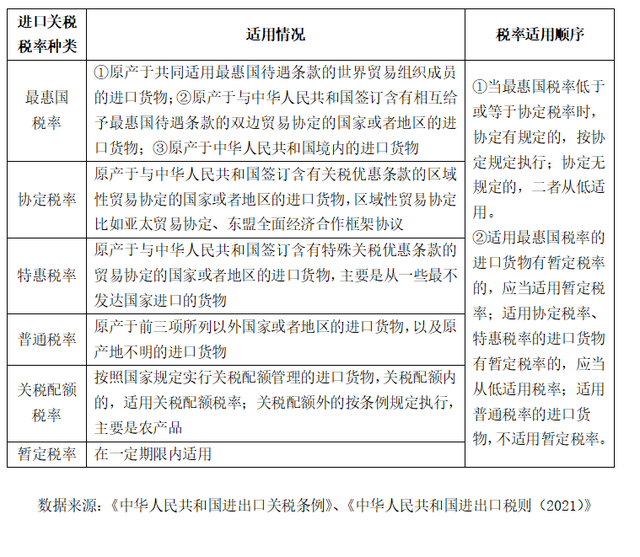
Currently, China's import tariff rates are set as most-favored-nation (MFN) tariff rates, conventional tariff rates, preferential tariff rates, general tariff rates, tariff quota rates, etc. Temporary tariff rates may also be applied to imported goods within a certain period.
In addition, if any country or region violates trade agreements and related agreements signed or jointly acceded to by the People's Republic of China and takes trade measures against the People's Republic of China, such as prohibition, restriction, additional tariffs, or other measures affecting normal trade, retaliatory tariffs may be imposed on imported goods originating from that country or region at the retaliatory tariff rates.
The application of each tariff rate is shown in the following table.
2. Determination of Import Tariff Rates for Coal
Import tariff rates for coal vary depending on the type of coal and the country/region of origin. The Import and Export Tariff Schedule of the People's Republic of China (2021) has specific provisions on the rates for different types of imported coal, as summarized in the following table.
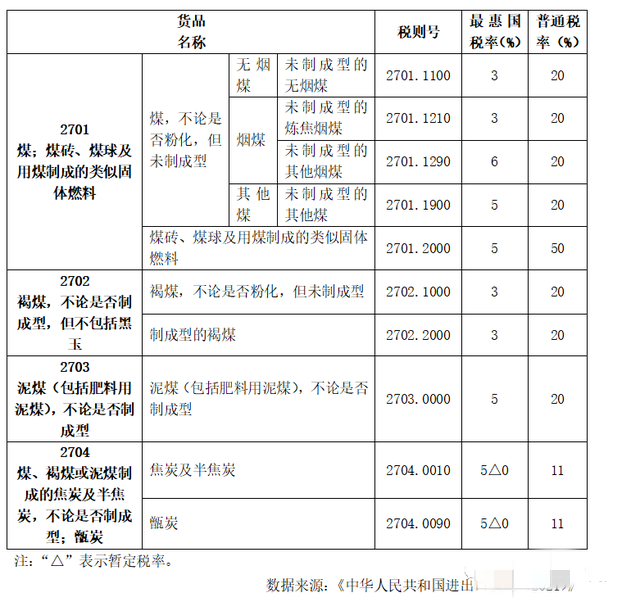
In the above table, regarding the classification of coal, Subheading Notes 1 and 2 of the Import and Export Tariff Schedule of the People's Republic of China (2021) have specific provisions, namely: "1. 'Anthracite' in subheading 2701.11 refers to coal with volatile matter (calculated on a dry, mineral-matter-free basis) not exceeding 14%. 2. 'Bituminous coal' in subheading 2701.12 refers to coal with volatile matter (calculated on a dry, mineral-matter-free basis) exceeding 14% and a calorific value (calculated on a moist, mineral-matter-free basis) equal to or greater than 5833 kcal/kg." The Import and Export Tariff Schedule of the People's Republic of China (2021) does not define lignite. With reference to the national standard GB/T 5751 "Classification of Chinese Coals", lignite includes two subcategories:
① Lignite No. 1: volatile matter Vdaf > 37%, light transmittance PM ≤ 30%;
② Lignite No. 2: volatile matter Vdaf > 37%, light transmittance 30%
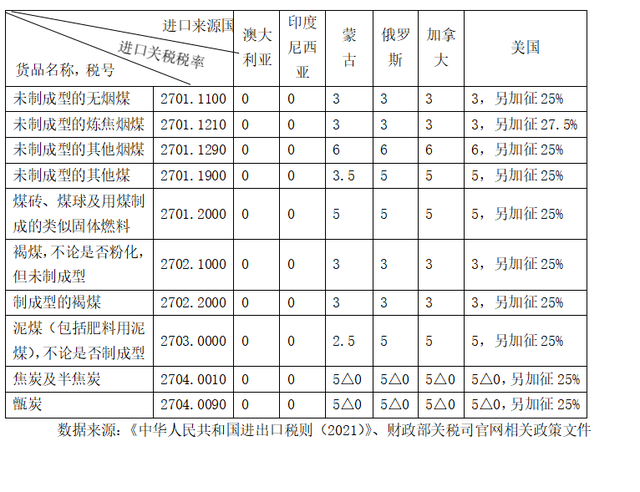
Regarding import source countries, China's major coal-importing source countries include Australia, Indonesia, Mongolia, Russia, Canada, the United States, and others. Among them, for coal imported from Australia, under the Free Trade Agreement between the Government of the People's Republic of China and the Government of Australia and the Import and Export Tariff Schedule (2021), the agreed tariff rate of 0 applies. For coal imported from Indonesia, under the Framework Agreement on Comprehensive Economic Cooperation between the People's Republic of China and the Association of Southeast Asian Nations and the Import and Export Tariff Schedule (2021), the agreed tariff rate of 0 applies. For coal imported from Mongolia, under the Asia-Pacific Trade Agreement and the Import and Export Tariff Schedule (2021), from January 1, 2021, some coal types are subject to the agreed tariff rates; the agreed tariff rates for other coal and peat are 3.5% and 2.5% respectively, and the remaining coal types are subject to the most-favored-nation (MFN) tariff rate. Coal imported from Russia and Canada is subject to the most-favored-nation tariff rate.
Coal imported from the United States is subject to additional tariffs in addition to the normal MFN tariff rate. Specifically, the Announcement of the Customs Tariff Commission of the State Council on Imposing Additional Tariffs on US$50 Billion of Imported Goods Originating from the United States (Customs Tariff Commission Announcement No. 5 [2018]) imposes an additional tariff of 25% on all coal imported from the United States, and no later exclusion has been made. The Announcement of the Customs Tariff Commission of the State Council on Imposing Additional Tariffs on Certain Imported Goods Originating from the United States (Third Batch) (Customs Tariff Commission Announcement No. 4 [2019]) imposes an additional tariff of 5% on non-agglomerated coking bituminous coal (HS code 2701.1210). However, the Announcement of the Customs Tariff Commission of the State Council on Adjusting the Additional Tariff Measures on Certain Imported Goods Originating from the United States (Customs Tariff Commission Announcement No. 1 [2020]) adjusts the additional tariff rate on non-agglomerated coking bituminous coal (HS code 2701.1210) to 2.5%. Since the final additional tariff rate is the sum of the additional tariff rates from all rounds, the additional tariff rate for non-agglomerated coking bituminous coal (HS code 2701.1210) imported from the United States is 27.5%, while the additional tariff rate for other coal imported from the United States is 25%. For goods subject to additional tariffs:
Additional tariff amount = duty-paying value × additional tariff rate
Customs duty = the amount of customs duty payable calculated at the current applicable rate + additional tariff amount
The tariff rates applicable to coal imported from major source countries are summarized in the following table.
IV. Application Examples
Suppose a Chinese enterprise imports non-agglomerated coking bituminous coal from the United States at a transaction price of CIF Qinhuangdao Port of US$125,000. On the date when the customs issues the duty payment notice, the foreign exchange rate quotations are: US$100 = RMB 637.8 (buying rate), US$100 = RMB 640.5 (selling rate). The customs duty is calculated as follows:
The customs reviews the declared price and, assuming it meets the “transaction price” condition, determines the tax rate: non-agglomerated coking bituminous coal (HS code 2701.1210) imported from the United States is subject to the MFN tariff rate of 3%, plus an additional tariff rate of 27.5%.
The exchange rate on the date when the customs issues the duty payment notice is:
Foreign exchange middle rate: US$100 = (637.8 + 640.5) ÷ 2 = RMB 639.15
That is, US$1 = RMB 6.3915
Dutiable value = 125 000 × 6.3915 = 798 937.5 RMB
Tariff = 798 937.5 × (3% + 27.5%) = 243 675.94 RMB
Import VAT = (798 937.5 + 243 675.94) × 13% = 135 539.75 RMB