1. Vale
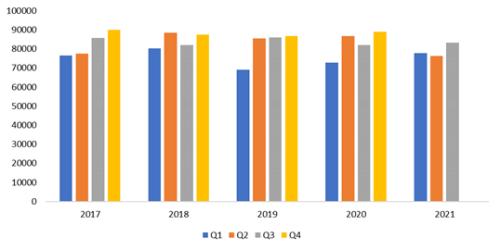
Vale third quarterIron oreThe production of iron ore fines was 89.4 million tons, an increase of 18.1% month-on-month and 0.8% year-on-year. So far, Vale's output for the first three quarters has reached 70%-74% of its full-year guidance, which is considered a relatively normal shipping pace. According to the anticipated full-year production stated in its announcement, which is expected to be in the lower-middle range of the guidance, if we calculate based on an annual output of 320 million tons, Vale's production in the fourth quarter would be approximately 87 million tons, a month-on-month decrease of 2.7% and a year-on-year increase of 2.9%.
2. Rio Tinto
Rio Tinto's iron ore production in the third quarter was 83.3 million tonnes (100% basis), up 10% quarter-on-quarter, but down 4% year-on-year. In this report, Rio Tinto has lowered its full-year shipment expectations to 320-325 million tonnes (previously expected at the lower end of 325-340 million tonnes). We believe that the impact of this downward adjustment of Rio Tinto's iron ore shipment target is relatively small. Based on 320 million tonnes, Rio Tinto's shipments in the fourth quarter are approximately 82.5 million tonnes, a decrease of 1% quarter-on-quarter and 7% year-on-year.
3. BHP
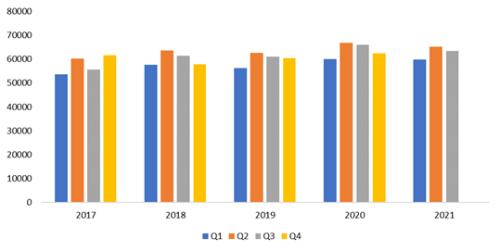
BHP's iron ore production in Western Australia for the third quarter was 63.3 million tons (71 million tons on a 100% basis), down 3% quarter-on-quarter and 4% year-on-year. The production guidance for fiscal year 2022 remains unchanged. Overall, BHP experienced a decline in both production and sales in the third quarter due to maintenance. However, since it has not adjusted its annual shipping target and stated that the negative impact has eased, considering the seasonal pattern of production, we expect BHP's production in the fourth quarter to remain largely flat.
4. FMG
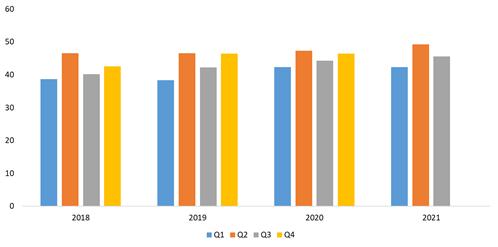
FMG's iron ore shipments in the third quarter were 45.6 million tons, up 3% from the second quarter, marking a record high for shipments in the first quarter of the fiscal year. Previous mine accidents have not affected the annual production and shipment targets. From a seasonal perspective, FMG's shipments in the fourth quarter may increase slightly quarter-on-quarter, and based on the current production and sales situation, FMG is expected to successfully achieve its 2022 fiscal year shipment target.
Overall, in the third quarter of 2021, the production and sales of the four major mines increased both sequentially and year-on-year. Based on the latest production guidance targets and shipment situations of each company, we expect the overall supply of the four major mines to slightly decline sequentially in the fourth quarter.
Table 1: Production and Sales Data of the Four Major Mines (Million Tons) |
|
Data source: public information,SDIC Anxin FuturesOrganize |
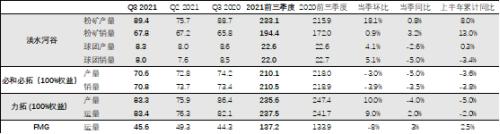
The following is a more detailed breakdown of the quarterly reports of the four major mines:
One
Vale S.A.
Vale's iron ore fines production in the third quarter was 89.4 million tons, representing an increase of 18.1% from the second quarter and an increase of 0.8% from the same period last year. The production growth was mainly due to seasonal weather improvements in the North, which boosted output at Serra Norte and S11D (9.5 million tons). In addition, other mines contributed positively to production growth (4.2 million tons) due to various improvements and an increase in third-party purchases. Vale's pellet production in the third quarter was 8.3 million tons, up 4.1% quarter-on-quarter but down 2.6% year-on-year, still constrained by raw material supply.
Figure 1: Vale Quarterly Production (Thousand Tons) |
|
Data source: public information, compiled by SDIC Anxin Futures |
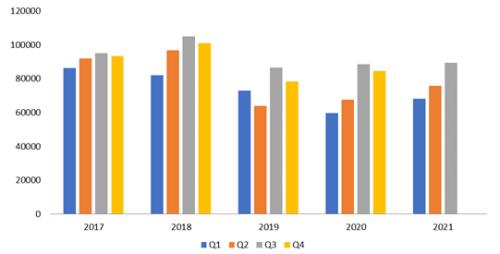
Vale stated that its production and sales strategy depends on the market environment, and it focuses more on value rather than output, emphasizing profit maximization. Therefore, in the fourth quarter, it will reduce the production of low-profit high-silica products by 4 million tons. Vale indicated that this move will not affect its full-year production guidance target (315-335 million tons), but it expects production to be in the lower to middle part of this target range. Vale also pointed out that if the market remains weak in the future, it will cut production of low-profit products by 12-15 million tons in 2022 and also adjust its purchases from third-party mines.
In terms of sales, Vale sold a total of 75.88 million tons of iron ore fines and pellets in the third quarter, an increase of 1.3% compared to the second quarter. There is a gap of 13 million tons between sales and production, mainly because Vale reduced the sales of low-margin high-silica products in September based on market prices, and due to inventory transfers between the supply chains. If the iron ore market improves in the fourth quarter, the above issues will be resolved.
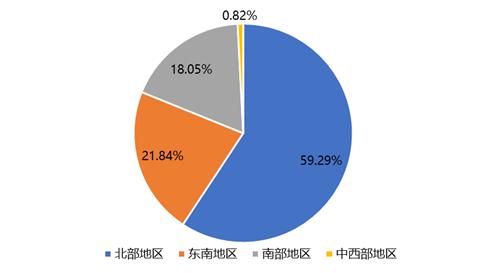
By region, the increase in Vale's production in the third quarter was mainly attributed to higher output in the northern areas under favorable weather, while production in the southern and southeastern areas also experienced some growth due to factors such as facility improvements.
Figure 2: Vale's Second Quarter Production Change by Region |
|
Data source: public information, compiled by SDIC Anxin Futures |
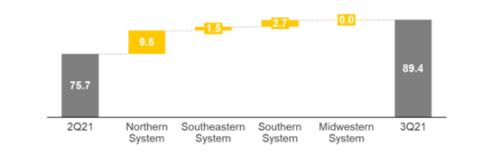
Northern System
The northern system's third-quarter production increased by 21.9% quarter-on-quarter, mainly due to good weather and less rainfall. However, compared to the third quarter of last year, production is still relatively low, mainly due to licensing delays and processing issues at the S11D ore body. Vale stated that it will install the remaining three ore crushers in the fourth quarter of this year and in 2022, which will increase S11D's capacity next year.
Southeast System
The continued improvement of the southeastern system is mainly due to the enhancement of ore quality in the Itabira and Mariana mines and the higher usability of hematite in the Brucutu region.
Southern System
The better performance of the southern system was mainly due to the improvement in dry processing production at the Vargem Grande mine, high procurement of third-party ore, and the Fabrica mine reaching full production. In addition, in the future, with the completion of the commissioning of the remote conveyor belt at the Vargem Grande dam, its capacity is expected to increase by 6 million tons.
Figure 3:Vale's third-quarter production by region |
|
Data source: public information, compiled by SDIC Anxin Futures |
Currently, Vale's production for the first three quarters has reached 70%-74% of the annual guidance, which is considered a relatively normal shipping pace and shows the capacity to meet the lower end of the 2021 production guidance target of 315 million tons. According to its announcement, the expected full-year production is in the mid-to-lower range of the guidance. Based on a full-year production of 320 million tons, Vale's production in the fourth quarter would be approximately 87 million tons, a quarter-on-quarter decrease of 2.7% and a year-on-year increase of 2.9%.
Two
Rio Tinto
Rio Tinto's iron ore production in the third quarter was 83.3 million tons (100% basis), up 10% from the second quarter but down 4% year-on-year. Third-quarter shipments were 83.4 million tons (100% basis), up 9% from the second quarter and up 2% year-on-year. Rio Tinto stated that the year-on-year decline in shipments was mainly due to heritage site protection issues and delays in the Robe Valley replacement project. SP10 production increased in the third quarter and is expected to continue into the fourth quarter.
Figure 4: Rio Tinto Q3 Production and Sales (100% interests) (kt) |
|
Data source: public information, compiled by SDIC Anxin Futures |
In this report, Rio Tinto has lowered its full-year shipment expectations to 320-325 million tons (previously expected at the lower end of 325-340 million tons), mainly due to labor shortages delaying the Gudai-Darri and Robe Valley mine projects. In addition, Rio Tinto has also lowered the shipment targets for Canadian company pellets and fines to 9.5-10.5 million tons (the original target was 10.5-12 million tons).
Figure 5:Rio Tinto Shipping Targets (Million Tons) |
|
Data source: public information, compiled by SDIC Anxin Futures |

We believe that the impact of Rio Tinto's downward adjustment of its expected iron ore shipment target is relatively small. On one hand, Rio Tinto had previously estimated full-year shipments at the lower end of the original target of 325 million tons, and this revision only lowers the shipment target by 5 million tons, so the impact in terms of volume is relatively minor. On the other hand, looking at Rio Tinto's shipments this year, the cumulative shipments so far are about 5 million tons less than the same period last year. This adjustment basically aligns with the actual situation and market expectations. Moreover, if Rio Tinto can maintain its current shipment pace, there is a high likelihood of achieving the new annual shipment target. Based on a figure of 320 million tons, Rio Tinto's shipments in the fourth quarter would be approximately 82.5 million tons, representing a month-on-month decrease of 1% and a year-on-year decrease of 7%.
Three
BHP
BHP's iron ore production in Western Australia for the third quarter was 63.3 million tons (71 million tons on a 100% basis), down 3% quarter-on-quarter and down 4% year-on-year. The production guidance for fiscal year 2022 remains unchanged at 246-255 million tons (278-288 million tons on a 100% basis). The decline in BHP's third-quarter production was mainly due to more routine quarterly maintenance schedules and temporary labor shortages in the railway caused by the pandemic. However, these issues were improved in September. In addition, strong mine operations and the optimization of mining cycles at Yandi partially offset the negative impacts mentioned above. Samarco's pellet production in Brazil was 1 million tons in the third quarter, and its fiscal year 2022 production target of 3-4 million tons remains unchanged.
Figure 6:BHP quarterly production (85% equity-owned Samarco production) (kt) |
|
Data source: public information, compiled by SDIC Anxin Futures |
BHP's South Flank mine is still in the process of ramping up production, and the goal of increasing capacity to 80 million tons (100% interest) over the next three years remains unchanged. In addition, on September 7, 2021, BHP received approval to increase the operating capacity of the Hedland Port to 330 million tons (100% interest). BHP's short-term goal is still to stabilize production at 290 million tons and then gradually increase it in the medium term. To achieve these goals, BHP's board recently approved a port project, which is expected to start in December this year.
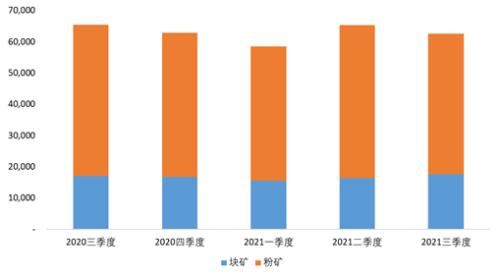
In terms of sales, BHP's total sales in Western Australia for the third quarter were 62.59 million tons (70.82 million tons on a 100% basis), down 4.1% from the second quarter and down 4.4% from the third quarter last year. By product type, lump ore sales were 17.55 million tons, up 6.9% quarter-on-quarter, while fines sales were 45.04 million tons, down 7.8% quarter-on-quarter.
Figure 7: BHP Sales by Product Type (85% Owned Interest) (Thousand Tons) |
|
Data source: public information, compiled by SDIC Anxin Futures |
Overall, BHP experienced a decline in both production and sales in the third quarter due to maintenance. However, since it has not adjusted its annual shipment target and has stated that the related negative impacts have eased, considering the seasonal pattern of production, it is expected that BHP's production in the fourth quarter will remain basically flat.
Four
FMG
FMG's iron ore shipments in the third quarter reached 45.6 million tons, an increase of 3% compared with the second quarter, setting a record for the first quarter of the fiscal year, and iron ore processing and rail transport volumes also reached new highs. In addition, despite rising inflationary pressures, FMG's C1 cost in the third quarter remained at 15.25.US Dollar/The wet tonnage remains unchanged, thanks to the good performance of the entire supply chain andEliwanaThe continuous increase in mine production.FMGMaintain2022Fiscal year's shipping target1.8-1.85One hundred million tons remain unchanged.
Figure 8: FMG Quarterly Freight Volume (Thousand Tons) |
|
Data source: public information, compiled by SDIC Anxin Futures |
FMG also stated that the Iron Bridge project, currently under construction, will in the future provide high-quality ore with 67% iron content, and the annual output will reach 22 million tons. According to the plan, the first production is scheduled to start in December 2022. In the past quarter, the construction of the Iron Bridge project facilities made some key progress.
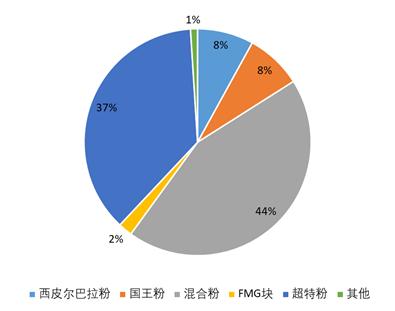
Looking at different ore types, in the third quarter FMG's production of blended fines and ultra-fines reached 20 million tons and 16.8 million tons, accounting for 44% and 37% of all products, respectively, with their share further increasing compared to the previous quarter; the production of other products such as lump ore and West Pilbara fines declined.
Figure 9: Proportion of FMG shipment volume by product type |
|
Data source: public information, compiled by SDIC Anxin Futures |
FMG's production and sales performance in the third quarter was relatively good, and the brief mining incident earlier did not affect the annual production and shipment targets. From a seasonal perspective, we expect FMG's shipments in the fourth quarter to increase slightly quarter-on-quarter, and based on the current production and sales situation, FMG is likely to complete the shipment targets for the 2022 fiscal year well.
Five
Summary
Overall, the production and sales of the four major mining companies in the third quarter of 2021 increased both quarter-on-quarter and year-on-year. Among them, Vale and Rio Tinto saw significant quarter-on-quarter increases in production and sales, while BHP and FMG experienced slight declines due to maintenance and seasonal effects. According to the latest production guidance and shipment situations of each company, we expect the overall supply from the four major mining companies to slightly decrease quarter-on-quarter in the fourth quarter, mainly due to a slight weakening in supply from Vale and Rio Tinto, with Vale proactively reducing shipments of low-margin products due to market conditions.